
Choosing a Local Nursing and Rehabilitation Facility After Surgery
Recovering from surgery or a serious illness is one of the most vulnerable—and critical—phases of your healthcare journey. Where you recover matters as much as how you recover. This guide explains why choosing a local skilled nursing and rehabilitation facility for post-acute care leads to better outcomes, faster healing, and greater peace of mind for patients and families alike.
What Is Post-Acute Care—and Why Does It Matter?

BHCC Nursing & Rehabilitation Recovery Room
After a hospital stay for surgery, a stroke, a joint replacement, a cardiac event, or another serious medical episode, most patients are not ready to return home immediately. This transition period—known as post-acute care (PAC)—is when the body does the hard work of healing, and when the risk of complications and readmission is highest.
Post-acute care environments include:
Skilled Nursing Facilities (SNFs) – 24/7 nursing care, wound management, IV therapy, and complex medical monitoring
Short-Term Rehabilitation Centers – Physical, occupational, and speech therapy to restore strength, mobility, and independence
Long-Term Care Facilities – For patients who need extended support beyond the acute recovery window
Choosing the right setting—and the right location—can be the difference between a smooth recovery and a costly, painful setback.
The 8 Key Benefits of Choosing a Local Nursing & Rehab Facility
1. Seamless Transitions Directly from the Hospital
One of the most medically significant advantages of a local skilled nursing facility is proximity to the discharging hospital. Care coordination teams—including hospital case managers, social workers, and discharge planners—can more easily:
Communicate directly with the SNF care team
Transfer medical records, imaging, and care plans quickly
Coordinate same-day or next-day admissions
Reduce gaps in medication management and wound care protocols
The bottom line: Shorter transfer distances mean faster care continuity—and fewer dangerous gaps in treatment.
2. Frequent Family Visits That Accelerate Healing
Research consistently shows that patients with strong family support systems recover faster and experience better mental health outcomes during rehabilitation. A nearby nursing and rehab center makes it practical—not just possible—for loved ones to:
Visit regularly without long commutes or travel costs
Participate in therapy sessions and care planning meetings
Monitor daily progress and advocate for the patient
Provide emotional support that no clinical team can fully replace
When a facility is 30 minutes away rather than two hours, visiting goes from a major commitment to a daily routine.
3. A Care Team That Knows Your Community
Local facilities don't just treat patients—they serve neighbors. Staff at community-based nursing and rehab centers often have:
Long-tenured relationships with regional hospitals and referring physicians
Familiarity with local specialists, pharmacies, and follow-up care providers
Cultural and linguistic connections that improve communication and comfort
Community reputation and accountability that drives higher care standards
A facility embedded in your community has a vested interest in your outcome—because your neighbors are watching.
4. Access to Specialized Rehabilitation Programs
Today's leading skilled nursing and rehabilitation facilities offer comprehensive, evidence-based therapy programs tailored to specific post-surgical and post-acute needs, including:
Orthopedic Rehab – Recovery from hip replacement, knee replacement, and spinal surgery
Cardiac Rehabilitation – Guided exercise, monitoring, and education following heart surgery or cardiac events
Neurological Rehabilitation – Recovery support for stroke, TBI, and Parkinson's disease
Pulmonary Therapy – Breathing exercises and oxygen management for respiratory conditions
Wound Care Management – Advanced dressing protocols and infection prevention for surgical sites
When this level of specialized care is available locally, patients don't have to choose between quality and proximity.
5. Reduced Risk of Hospital Readmission
Hospital readmissions are one of the most serious—and costly—risks in post-surgical recovery. The 30-day readmission rate for Medicare patients discharged to skilled nursing facilities averages around 20%, but high-quality local SNFs consistently outperform national benchmarks by maintaining:
Rigorous medication reconciliation processes
Daily vital sign monitoring and early warning protocols
Rapid communication with the patient's primary care physician and surgeon
On-site physician or NP coverage to handle complications before they escalate
Choosing a friendly and patient-centered local SNF dramatically lowers your readmission risk compared to recovering at home without professional oversight.
6. Insurance Coordination Is Easier and More Transparent
Navigating Medicare, Medicaid, and private insurance coverage for skilled nursing care is complex. Local facilities with established relationships in your area are better positioned to:
Verify your coverage before admission
Communicate directly with your insurance provider or managed care plan
Help you understand your financial responsibilities upfront
Coordinate Medicare's 100-day skilled nursing benefit (Part A) efficiently
Many families are surprised to learn that Medicare covers up to 100 days of skilled nursing facility care following a qualifying hospital stay of 3 or more days—at no cost for the first 20 days. A knowledgeable local admissions team can walk you through exactly what your plan covers.
7. Continuity of Care After Discharge
The relationship with a local facility doesn't have to end at discharge. Top-tier community nursing and rehab centers offer robust discharge planning and follow-up services, including:
Home health referrals and coordination
Outpatient therapy connections
Medication reconciliation with your primary care provider
Follow-up calls and wellness check-ins post-discharge
Clear communication with your surgeon's office and specialist team
This continuity is nearly impossible to replicate when a patient is discharged from a distant facility back into an unfamiliar community.
8. Peace of Mind for the Entire Family
Recovery is hard. Uncertainty makes it harder. When your loved one is at a local, trusted nursing and rehab center, families experience:
Reduced anxiety from being able to visit anytime
Confidence from knowing the staff by name
Comfort from a familiar environment and community connections
The ability to quickly address concerns with the care team in person
This psychological dimension of recovery is often undervalued—but it is clinically significant. Patients who feel safe and supported heal faster.
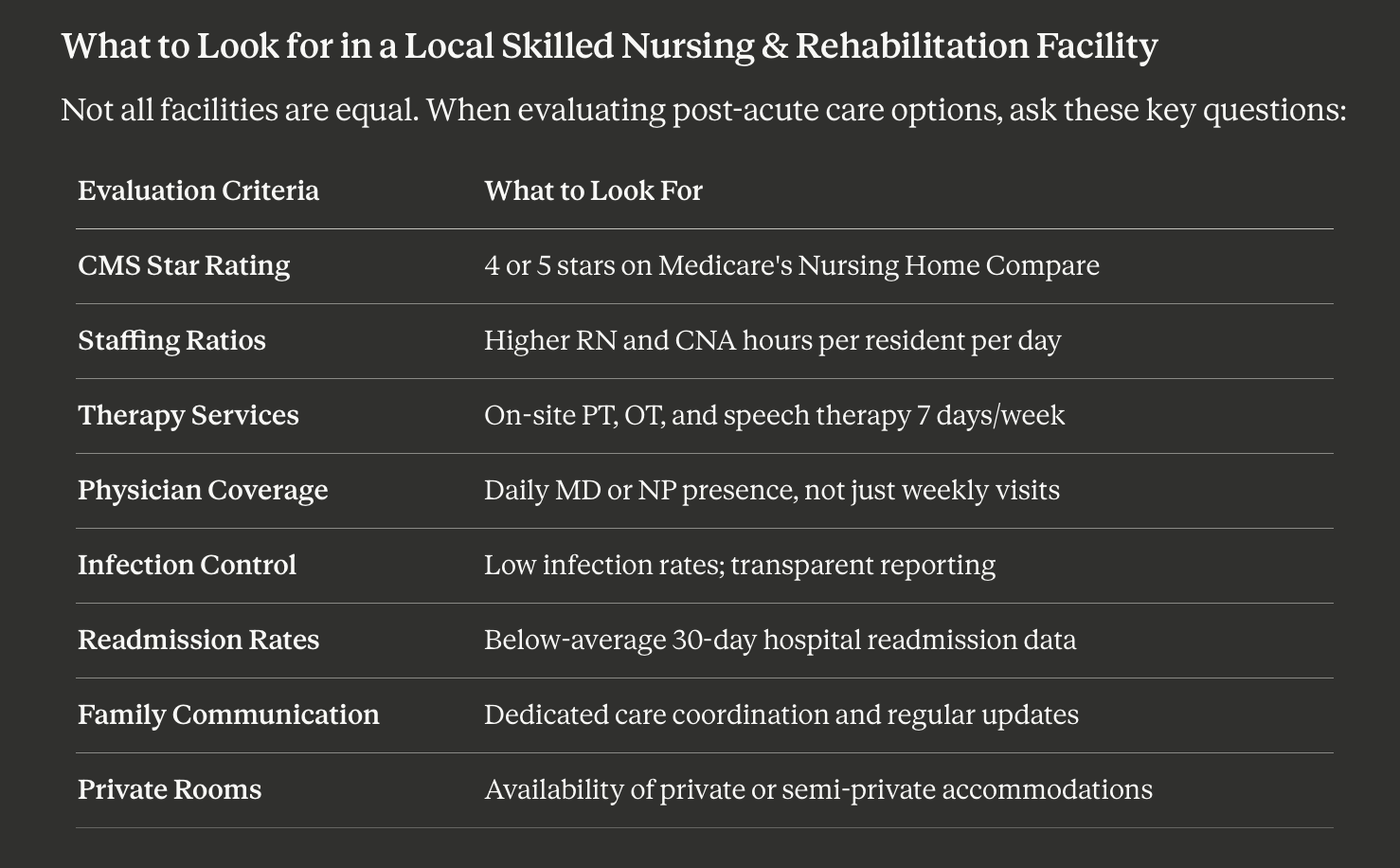
What to Look for in a Local Skilled Nursing & Rehabilitation Facility
Not all facilities are equal. When evaluating post-acute care options, ask these key questions:
What To Look For In a Skilled Nursing Home
Common Questions About Post-Acute Care in a Skilled Nursing Facility
Q: How long will I need to stay in a skilled nursing facility after surgery? The typical short-term rehab stay ranges from 10 to 30 days, depending on the procedure, your age, baseline health, and how quickly you progress through therapy milestones. Your care team will set individualized discharge goals from day one.
Q: Does Medicare cover skilled nursing facility care? Yes—Medicare Part A covers SNF care following a qualifying inpatient hospital stay of 3 or more consecutive days. Coverage includes up to 20 days at 100%, and days 21–100 with a daily copay. After day 100, other coverage (Medicaid, supplemental insurance) may apply.
Q: Can I choose my own skilled nursing facility, or does the hospital decide? You have the right to choose your own facility. Federal law requires hospitals to provide you with a list of local SNF options and honor your preference. Don't let the discharge process rush you—ask for the options and take time to research.
Q: What's the difference between a skilled nursing facility and a regular nursing home? A skilled nursing facility (SNF) provides medically necessary care and therapy that requires licensed professionals—nurses, physical therapists, occupational therapists. A traditional nursing home is typically for long-term custodial care. Many facilities offer both, but short-term rehab is a distinct, intensive service.
Q: What should I bring to a skilled nursing facility? Plan to bring comfortable clothing suitable for therapy, personal care items, a list of current medications, insurance cards, and any adaptive equipment you already use (eyeglasses, hearing aids, etc.). The admissions team will provide a full checklist.
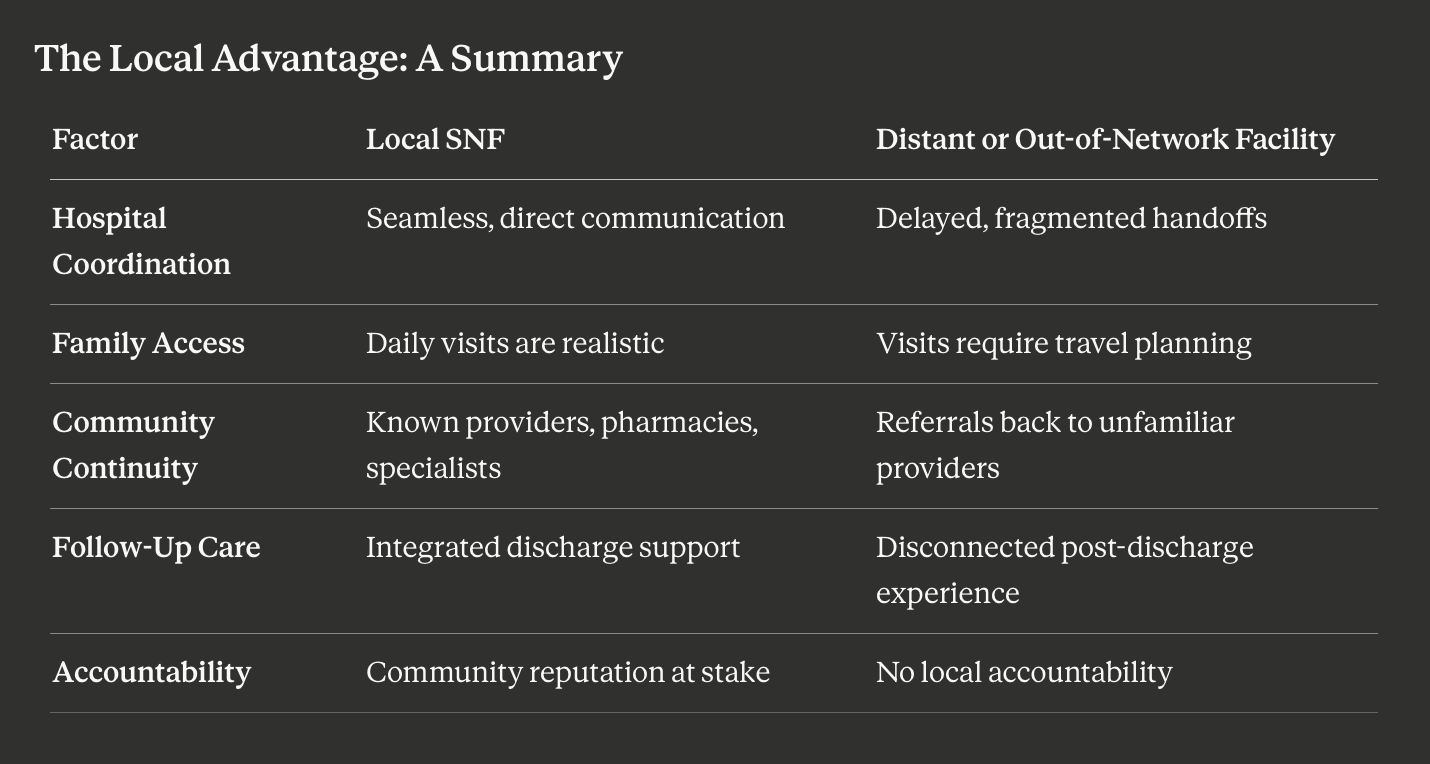
The Local Advantage: A Summary
Advant Of Local Nursing Home
Planning care after surgery
When comparing local facilities, discuss your care needs, rehabilitation goals, insurance benefits and discharge plan with the hospital team and each facility.
Explore short-term rehabilitation at Brush Hill and our skilled nursing services. You can also contact our team to discuss care or arrange a tour.